FAMOUS COLORED DIAMONDS.
There are several famous colored diamonds that have gained significant recognition and fame. Here are a few examples.
The hope diamond.
The Hope Diamond, also known as "Le Bijou du Roi" ("the King's Jewel") "Le bleu de France" ("the Blue of France"), and the Tavernier Blue, is a large, 45.52-carat (9.104 g) deep-blue diamond, now housed in the Smithsonian Natural History Museum in Washington, D.C. It is blue to the naked eye because of trace amounts of boron within its crystal structure, and exhibits red phosphorescence after exposure to ultraviolet light. It is classified as a Type IIb diamond, and is notorious for supposedly being cursed. It has a long recorded history, with few gaps, in which it changed hands numerous times on its way from India to France to Britain and to the United States. It has been described as the "most famous diamond in the world.
Moussaieff Red Diamond.
The Moussaieff Red Diamond (formerly known as the Red Shield Diamond) is a diamond measuring 5.11 carats (1.022 g) with a triangular brilliant cut (sometimes called a trillion or a trilliant cut), rated in color as Fancy Red by the Gemological Institute of America. It is the world's largest known red diamond.
The Moussaieff Red was discovered in the 1990s by a Brazilian farmer in the Abaetezinho river in 1990, in a region known as Alto Paranaiba. The rough stone weighed 13.9 carats (2.78 g) The diamond was purchased and cut by the William Goldberg Diamond Corp. where it went by its original name, the Red Shield. It was purchased in 2001 or 2002 by Shlomo Moussaieff, an Israeli-born jewelry dealer in London, and is currently owned by Moussaieff Jewellers Ltd.
The Moussaieff Red was displayed as part of the Smithsonian's "The Splendor of Diamonds" exhibit, alongside The De Beers Millennium Star and The Heart of Eternity.
The Pink Srar Diamond.
The Pink Star, formerly known as the Steinmetz Pink, is a diamond weighing 59.60 carats (11.92 g), rated in color as Fancy Vivid Pink by the Gemological Institute of America. The Pink Star was mined by De Beers in 1999 in South Africa, and weighed 132.5 carats in the rough. The Pink Star is the largest known diamond having been rated Vivid Pink. As a result of this exceptional rarity, the Steinmetz Group took a cautious 20 months to cut the Pink. It was unveiled in Monaco on 29 May 2003 in a public ceremony.
The Pink Star was displayed (as the Steinmetz Pink) as part of the Smithsonian's "The Splendor of Diamonds" exhibit, alongside the De Beers Millennium Star, the world’s second largest (the Centenary Diamond is the largest) top colour (D) internally and externally flawless pear-shaped diamond at 203.04 carat (40.608 g), the Heart of Eternity Diamond, a 27.64 carat (5.582 g) heart-cut blue diamond and the Moussaieff Red Diamond, the world's largest known Fancy Red diamond at 5.11 carats (1.102 g).
The Pink Star was sold privately in 2007 but neither the identity of the buyer nor the price is on public record.
Dresden Green Diamond.
The Dresden Green Diamond, also known as "Dresden Green", is a 41 carats (8.2 g) natural green diamond, which probably originated in the Kollur mine in the state of Andhra Pradesh in India.
The Dresden Green is a rare Type IIa, and it is said to be internally flawless.
It is named after Dresden, the capital of Saxony, Germany where it has been on display for most of the last two centuries. Today, the diamond is shown in the "New Green Vault" at Dresden Castle.
The Dresden Green Diamond has a historical record dating back to 1722, when a London news-sheet carried an article about it in its 25 October-27th edition. It was acquired by Augustus III of Poland from a Dutch merchant in 1742 at the Leipzig Fair.[2] In 1768, the diamond was incorporated into an extremely valuable hat ornament, surrounded by two large and 411 medium-sized and small diamonds. This is the setting that the Dresden Green still appears in today.
In 2000, American jeweler, Harry Winston arranged to display the Dresden Green at the New York flagship store and then at theSmithsonian in Washington DC, USA, where it was displayed in the Harry Winston pavilion next to the largest blue diamond in the world, the Hope Diamond.
The Allnatt Diamond.
The Allnatt Diamond is a diamond measuring 101.29 carats (20.258 g) with a cushion cut, rated in color as Fancy Vivid Yellow by the Gemological Institute of America. This diamond is named after one of its holders, Major Alfred Ernest Allnatt, a soldier, sportsman, art patron and benefactor. While it is not known precisely where the Allnatt originated, many experts believe that it was probably found in what is now known as the De Beers Premier Diamond Mine.The Allnatt's origins are unknown prior to Major Allnatt's purchasing of the diamond in the early 1950s. After purchasing the diamond, he commissioned Cartier to make a setting for it. The final setting was a platinum flower with five petals, a stem and two leaves, all set with diamonds. The Allnatt was resold at auction in May 1996 by Christie's in Geneva for $3,043,496 US. At the time of its sale the Allnatt was 102.07 carats (20.414 g). and was graded Fancy Intense Yellow. After being sold to the SIBA Corporation, the diamond was re-cut to its current weight and the intensity was upgraded as a result.The Allnatt was displayed as part of the Smithsonian's "The Splendor of Diamonds" exhibit, alongside The De Beers Millennium Star and The Heart of Eternity.
Blue Moon of Josephine.
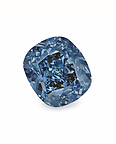
The Blue Moon of Josephine is one of the rarest and most extraordinary diamonds ever discovered, representing the absolute pinnacle of colored diamond excellence. Weighing 12.03 carats, this exceptional gemstone is graded Fancy Vivid Blue, the highest and most coveted color classification awarded by the GIA for blue diamonds—a designation achieved by only a minute fraction of diamonds worldwide.
Expertly fashioned into a refined cushion cut, the diamond displays remarkable symmetry and depth, allowing light to interact with its facets in a mesmerizing display of brilliance and saturation. Its color is an intense, pure blue with extraordinary richness and uniformity, a result of trace amounts of boron within the crystal lattice—an extremely rare natural phenomenon.
The diamond boasts Internally Flawless (IF) clarity, an exceptional characteristic that further elevates its rarity and value. Under magnification, it reveals an impeccably clean internal structure, enhancing its transparency and optical performance.
Discovered in South Africa at the Cullinan mine—one of the most legendary diamond sources in history—the Blue Moon was later named “The Blue Moon of Josephine” after being acquired at auction by a private collector. In 2015, it was sold at Sotheby’s Geneva for approximately $48.4 million, setting a world record at the time for the highest price per carat ever paid for a diamond.
Beyond its staggering monetary value, the Blue Moon stands as a symbol of timeless beauty, extreme rarity, and natural perfection. It is not merely a gemstone, but a masterpiece of nature—one that continues to captivate collectors, gemologists, and connoisseurs across the globe.
The De Grisogono Green Diamond.
Value: $7.3 million.
This beautiful diamond has the power to convince any beauty to accept the advances of a suitor. The de Grisogono Green Diamond is the crowning glory of a stunning white gold ring that is surrounded with black diamonds worth seven carats. The de Grisogono Green Diamond is a rare pale green diamond. The only other diamond that can rival this beauty is the 41-carat Dresden Green, which is on display at the Dresden Castle in Germany. The de Grisogono Green Diamond is a cushion-cut gem measuring 25 carats. In December 2006, jewelry house de Grisogono offered this rare gem on sale.
The Oppenheimer Blue.
The Oppenheimer Blue is a legendary 14.62-carat Fancy Vivid Blue diamond, recognized as the largest diamond of this color grade ever sold at auction. In 2016, it made history at Christie’s Geneva, achieving a final price of over $57 million and setting a world record price per carat for any diamond sold publicly.
Formerly owned by Sir Philip Oppenheimer, a leading figure of De Beers, the diamond is graded VVS1 clarity by the GIA. Its pure, intense blue hue, combined with a refined rectangular step (emerald) cut, gives the stone exceptional transparency and presence. Today, the Oppenheimer Blue is widely regarded as a benchmark for Fancy Vivid Blue diamonds, symbolizing the extreme rarity and enduring investment appeal of elite colored diamonds.
These are just a few examples of famous colored diamonds, but there are many more notable and valuable colored diamonds with their own unique stories and characteristics.